Friday, October 31, 2008

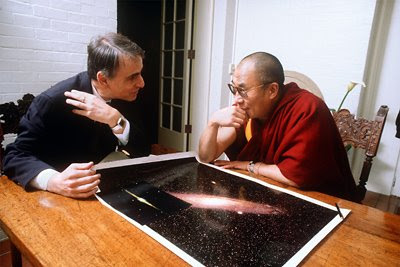
Einstein And The Buddha

Einstein And The Buddha

- Venerable S.Dhammika

The other day someone passed me a book called Einstein and the Buddha – Parallel Sayings by Thomas J. Farlane. ‘Now that might be an interesting read’ I thought to myself. If ever you need to be reminded of the truth of that old saying ‘You can’t judge a book by its cover’ read this little publication. Out of 125 quotations only 18 are attributed to the Buddha and of these only one is from the Dhammapada while all the rest are from Dwight Goddard’s A Buddhist Bible. Now you probably know that Goddard’s book would have to be the most unreliable rendering of Mahayana sutras ever published. Where there was something which didn’t fit into what Goddard thought the Buddha should have taught he just changed it accordingly. Even poor old Einstein hardly gets a hearing in Farlane's book; there are only 25 quotes from him. The rest are from Taoist text, Vedantic scriptures, Sri Aurobindo and some people I have never heard of; Godjin M. Nagao, Jagadish Chandra Chatterji, Cheng Chien, etc. As is often the case, Farlane uses ‘Buddha’ as a general catch-phrase for any vague, feel-good or ‘deep’ spirituality.
One quotation by David Bohn says, ‘Matter is like a small ripple on this tremendous ocean of energy, having some relative stability and being manifest…And in fact beyond that ocean may be still a bigger ocean…the ultimate source is immeasurable and cannot be captured within out knowledge’. The supposed ‘parallel’ saying by the Buddha is, ‘Universal Mind is like a great ocean, its surface is ruffled by waves and surges but its depths remain forever unmoved’. Now I’m just a simple monk and I’ve probably got it completely wrong, but it seems to me that the first quote is talking about matter while the second is talking about the mind. The first is positing unknowability while the second is asserting immovability. In fact, the only thing these quotes seem to have in common is the simile of the ocean. Many of the other ‘parallel’ sayings in this book are just as tenuous.
Einstein and the Buddha is, sad to say, a good example of the sort of thing I discussed on by post of 21, 4, 2008. The Buddha continues to get co-opted by those who wish to use him to support whatever they happen to believe in. The mechanism of this co-opting goes something like this. Where there is no authentic saying to support my beliefs I simply create one and where there is one that contradicts what I believe I either ignore it or claim that it was ‘put in later by the monks’. And whala! The Buddha is anything I want him to be – a strict vegan, a Rastafarian, an advocate of the healing power of crystals, a socialist, a free-marketer, an Aquarian Christian and an Inuit walrus worshipper who taught exactly what Teilhard de Chardin did and who came from outer space to exhort humanity to live in harmony. Of course poor old Jesus is subjected to this kind of treatment too but the wide availability of and knowledge about the Bible limits this to some extent. This is not the case with the Buddha. Authentic and complete translations of the Buddha’s words have only lately become available and even now are not widely read.
In the introduction to his humorous, readable and well-informed book The Gods Drink Whiskey Stephen Asma says, ‘It is my mission in life to take the ‘California’ out of Buddhism. Maybe that’s because I’m a Chicagoan – the son of a steelworker. Chicago Buddhism, if there is such a thing, is bound to be gritty, straightforward and down to earth. My blunt style may occasionally jar the sensibilities of more delicate, cheerful, colonic types. But rest assured, it is not certainty but only geographic temperament that gives timbre to my voice…Often the stuff that passes for ‘Eastern’ in the West would be unrecognizable in the East. The reason why so many Westerners become hopelessly muddled about Eastern ideas is that they have little interest in them per se. Many Western searches want the East on their terms. For Americans, Buddhist, Tantric or Taoist ideas have become like herbal remedies that one picks up at the local high-priced organic boutique-grocer…Consequently, Eastern ideas in the West float about like little self-esteem life-preservers – clung to desperately by disintegrating personalities. American Buddhists frequently go no further than, ‘This is what Buddhism means to me’, never seeing the narcissism in this approach and never bothering to understand Buddhism in its own terms’.
This is not my mission in life but I’m glad it is someone’s. Keep trucking Stephen! The tragedy of ‘California Buddhism’ is not that it is just shallow and inauthentic but that the Dhamma’s many unique insights can never challenge our assumptions, stimulate us to reassess what we already believe or get us to consider other possibilities. In short, it never help us to grow.

Monday, October 27, 2008

Facilitators and organisers of CEP 2008,

PLEASE SUBMIT YOUR CAMP FORM, FACILITATORS TRAINING CAMP FORM AND CAMP FEES THIS COMING SATURDAY,


1 Nov 2008

Sunday, October 26, 2008

Lets make a difference to someone's life

This is an amazing and inspiring article by Bhante Ven S. Dhammika from his blog. Take your time to digest it.

A few years ago while I was staying at a Buddhist society in Europe I was informed that at 3 in the afternoon someone was coming to see me to talk about the Dhamma. Just before 3 I heard the front gate open and I saw a man in a wheelchair entering the premises. After a bit of fuss getting the wheelchair through the front door the man was pushed into the library by the person accompanying him and I entered to meet him. As we introduced ourselves he held out his hand, I took it and his grip nearly crushed my hand as he shook it. He was a good-looking man of about 25 with a fine complexion and well-developed arms and chest.

Almost immediately he got down to business. ‘Two years ago I was in a car accident in which the driver, my friend, and another person were killed. I was left paralyzed from the waist down. I’m undergoing therapy at present but the doctors tell me that if I have not regained the use of my legs within another 12 months I probably never will. I have decided that if I can’t walk again by that time I’m going to kill myself’. He paused for a moment, letting this piece of information sink in. Then he continued. ‘I have gone to Catholic and Protestant clergymen, a rabbi, a Baha’i teacher and a Hindu swami to ask them if they can give me good reasons why I should not end my life. Now I want to know what a Buddhist would say about this. That’s why I’m here.’ All this was said in a no-nonsense, matter-of-fact manner that convinced me he meant what he said. I asked him, ‘What did these other religious teachers say to you?’ ‘They all said I shouldn’t do it’ he replied. ‘Is being in a wheelchair so terrible,’ I asked him. ‘I will never get an erection again. I leak urine. You can probably smell it a bit. I can’t shit any more like normal people. Every morning I have to remove it manually. I used to love sports, I was a real sportsman. Ill never be able to run and jump like I used to. For the rest of my life I’m going to have to depend on others and quite simply, I don’t want to live like that.’ As he said this I detected a hint of emotion in his voice for the first time. I asked, ‘And have you given any thought to how you intend to kill yourself?’ ‘Gas’ he replied, ‘Its quick, clean and painless. So that’s it. Can you, as an expert in Buddhism, give me one good reason why I shouldn’t kill myself?’ I listened to all this and decided to take the approach I have sometimes found useful in such cases. I spent a few moments pretending to ponder his question and then I said. ‘No I can’t. Given your circumstanced I think suicide is your best option.’ He opened his mouth to say something but nothing come out. He must have assumed that I was going to try to convince him not to kill himself and when I didn’t respond as expected he was knocked off balance. His friend who was standing behind him gave me a horrified look and waved his hand indicating that I should not say such a thing. ‘So you agree. You think I should kill myself?’ ‘Yep, I said.’ Now it was my turn to be silent while my words sunk in.

Finally I said, ‘The only thing I think you should reconsider is how your going to commit suicide. May I recommend another way?’ ‘Er, yes’ he said. His friend looked down and shook his head in despair. ‘This is what I would recommend. I live in Sri Lanka, in Kandy up in the mountains. Every time I go to the town market I see dozens of young guys on all fours crawling around amongst the crowd begging for money or food. They’ve all been crippled by polio. Now because they spend all their time down near ground level and are always breathing in dirt and dust, they often get lung infections. And of course because they crawl around their hands and knees are bruised, calloused and covered with scabs. I also know that almost none of them get any help from the government or any charitable organizations. They live by begging and petty theft.


Now this is what I recommend you do. Sell everything you have, go to Sri Lanka, get yourself a one year visa, and do everything you can to improve the lives of these young guys. They have lived on the streets for years so they are a pretty tough bunch. I will be more than happy to give you contacts in Kandy who can help you get a house and the other things you will need. Of course there are no facilities for wheelchair-bound people in Sri Lanka, no ramps or anything. The pavements are uneven and the roads full of pot holes, so getting around will be a constant struggle. I calculate that two years of this plus the strain of working with these very difficult kids should finish you off. I think the only problem you might have is that someone might come to know of what you are doing and try to help you which might prolong your life or even stave of death altogether. But you can always tell them to piss off.’ I said all this in the same no-nonsense tone that he had used when telling me of his resolve to commit suicide. He sat looking at me for a while and then we had a long talk.


I can understand and I sympathize with the terminal patient who is in great pain and who wishes to end (or perhaps better, to shorten) his or her live. But to want to kill yourself just because your life is not going the way you want it, is, to me at least, nanarcisistic, selfish and stupid. The ‘If I can’t win I’m going to take my ball and go home’ attitude to life bewilders me. In Vienna I met a distinguished surgeon who told me his life had become meaningless since he retired some years previously. He didn’t know what to do with himself and was increasingly suffering from bouts of depression. I felt like grabbing him by the collar and shouting, ‘You selfish old man!’ With the skills he had developed during his career there was so much he could do for others – tutoring young medical students, volunteering his knowledge to some charitable organization, spending periods during the year in an undeveloped country passing on his skills to surgeons there. And even if he didn’t want to share what he knew, he could travel, write a book, do some research or take up a hobby. But for whatever reason such possibilities just never occurred to him. The Buddha said that to be reborn as a human is a rare opportunity pregnant with possibilities (S.V,457). To squander that opportunity, to fail to see its potential or to be so fixated on one particular course that it blocked out all others, seems to me to be a terrible tragedy; far worse than being confined to a wheelchair or paralyzed from the neck down. I am not advocating that ‘you can achieve anything if you really want it’ or that ‘never give up’ approach to life so popular in America. The first is a delusion – you can’t achieve anything you want; life is full of limitations. And the second is almost a recipe for unhappiness – knowing when to gracefully surrender, when its time to call it quits, is a mark of good judgment. I am talking about an appreciative awareness of the fact that we are alive and using the time we have well. Yes, we may find obstacles in our way, sometimes very serious ones, so we may have to modify our goals, adjust our expectations or consider completely new ones. I am constantly astonished at how people with serious disabilities find fulfilling and creative ways to spend their time or make their lives meaningful. Daniel James’ self-pity, lack of imagination and willfulness led him to take his life. How very sad.


When I returned to the Buddhist society the next year the young man in the wheelchair came to see me again. He invited me to lunch in the flat he had just bought and where I met his new girlfriend, who quite coincidently, happened to be a Buddhist. I didn’t ask him if he had changed his mind about killing himself but I assumed he had.


Bhante Ven S. Dhammika had the privilege of making a significant difference to someone’s life… How about you? Let’s start by making a difference with the people in our family and friends in SBM by learning to cherish and guide one another.

Wednesday, October 22, 2008

Buddhism, The only real science


by Ajahn Brahmavamso

I used to be a scientist. I did Theoretical Physics at Cambridge University, hanging out in the same building as the later-to-be-famous Professor Stephen Hawking. I became disillusioned with such science when, as an insider, I saw how dogmatic some scientists could be. A dogma, according to the dictionary, is an arrogant declaration of an opinion. This was a fitting description of the science that I saw in the labs of Cambridge. Science had lost its sense of humility. Egotistical opinion prevailed over the impartial search for Truth. My favourite aphorism from that time was:

"The eminence of a great scientist, is measured by the length of time that they OBSTRUCT PROGRESS in their field"!

To understand real science, one can go back to one of its founding fathers, the English philosopher Francis Bacon (1561 - 1628). He established the framework on which science was to progress, namely "the greater force of the negative instance". This meant that, having proposed a theory to explain some natural phenomenon, then one should try one's best to disprove it! One should test the theory with challenging experiments. One must put it on trial with rigorous argument. When a flaw appears in the theory, only then does science advance. A new discovery has been made enabling the theory to be adjusted and refined. This fundamental and original methodology of science understood that it is impossible to prove anything with absolute certainty. One can only disprove with absolute certainty.

For example, how can one prove the basic law of gravity that "what goes up comes down, eventually"? One may throw objects up one million times and see them fall one million times. But that still does not prove "what goes up comes down". For NASA might then 'throw' a Saturn rocket up into space to explore Mars, and that never comes down to earth again. One negative instance is enough to disprove the theory with absolute certainty.

Some misguided scientists maintain the theory that there is no rebirth, that this stream of consciousness is incapable of returning to a successive human existence. All one needs to disprove this theory, according to science, is to find one instance of rebirth, just one! Professor Ian Stevenson, as some of you would know, has already demonstrated many instances of rebirth. The theory of no rebirth has been disproved. Rebirth is now a scientific fact!

Modern science gives a low priority to any efforts to disprove its pet theories. There is too much vested interest in power, prestige and research grants. A courageous commitment to truth takes too many scientists out of their comfort zone. Scientists are, for the most part, brainwashed by their education and their in-group conferences to see the world in a very narrow, microscopic, way. The very worst scientists are those who behave like eccentric evangelists, claiming that they alone have the whole truth, and then demanding the right to impose their views on everyone else.

Ordinary people know so little about science that they can hardly even understand the jargon. Yet, if they read in a newspaper or magazine "a scientist says that?", then they automatically take it to be true. Compare this to our reaction when we read in the same journal "a politician says that?"! Why do scientists have such unchallenged credibility? Perhaps it is because the language and ritual of science has become so far removed from the common people, that scientists have become today's revered and mystical priesthood. Dressed in their ceremonial white lab coats, chanting incomprehensible mumbo jumbo about multi-dimensional fractal parallel universes, and performing magical rituals that transubstantiate metal and plastic into TV's and computers, these modern day alchemists are so awesome we'll believe anything they say. Elitist science, as once was the Pope, is now infallible.

Some know better. Much of what I learnt 30 years ago has now been proved wrong. There are, fortunately, many scientists with integrity and humility who affirm that science is, at best, a work still in progress. They know that science can only suggest a truth, but can never claim a truth. I was once told by a Buddhist G.P. that, on his first day at a medical school in Sydney, the famous Professor, head of the Medical School, began his welcoming address by stating "Half of what we are going to teach you in the next few years is wrong. Our problem is that we do not know which half it is!" Those were the words of a real scientist.

Some evangelical scientists would do well to reflect on the (amended) old saying "Scientists rush in where angels fear to tread" and stop pontificating about the nature of the mind, happiness and even Nirvana. Neurologists are especially prone to such neuroses (Neurosis: an undue adherence to unrealistic ideas of things). They are claiming that the mind, awareness and will, is now adequately explained by activity in the brain.

This theory was disproved over 20 years ago by Prof. Lorber's discovery of the student at Sheffield University with and IQ of 126, a First Class degree in mathematics, but with virtually no brain (Science, Vol. 210, 12 Dec 1980)! More recently, it was disproved by Prof. Pim Van Lommel, who demonstrated the existence of consciousness activity after clinical death, i.e. when all brain activity has ceased (Lancet, Vol. 358, 15 December 2001, p 2039).

Although there may be correlation between a measurable activity in part of the brain and a mental impression, such co-occurrence doesn't always imply that one is the cause of the other. For instance, some years ago, research showed a clear correlation between cigarette smoking and the non-occurrence of Alzheimer's disease. It was not that smoking cigarettes somehow caused immunity from Alzheimer's, as much as the tobacco companies might have wished, it was only that many smokers did not live long enough to get > Alzheimer's disease! Thus a co-incidence of two phenomena, even when repeated, does not mean that one phenomenon is the cause of the other. To claim that activity in the brain causes awareness, or mind, is plainly unscientific.

Buddhism is more scientific than modern science. Like science, Buddhism is based on verifiable cause-and-effect relationships. But unlike science, Buddhism challenges with thoroughness every belief. The famous Kalama Sutta of Buddhism states that one cannot believe fully in "what one is taught, tradition, hearsay, scripture, logic, inference, appearance, agreement with established opinion, the seeming competence of a teacher, or even in one's own teacher". How many scientists are as rigorous in their thinking as this? Buddhism challenges everything, including logic.

It is worth noting that Quantum Theory appeared quite illogical, even to such great scientists as Einstein, when it was first proposed. It is yet to be disproved. Logic is only as reliable as the assumptions on which it is based. Buddhism trusts only clear and objective experience.

Clear experience occurs when one's measuring instruments, one's senses, are bright and undisturbed. In Buddhism, this happens when the hindrances of sloth-and-torpor and restlessness-and-remorse are both overcome. Objective experience is that which is free from all bias. In Buddhism, the three types of bias are desire, ill will and sceptical doubt. Desire makes one see only what one wants to see, it bends the truth to fit one's preferences. Ill will makes one blind to whatever is disturbing or disconcerting to one's views and it distorts the truth by denial. Sceptical doubt stubbornly refuses to accept those truths, like rebirth, that are plainly valid but which fall outside of one's comforting worldview. In summary, clear and objective experience only happens when the Buddhist 'Five Hindrances' have been overcome. Only then can one trust the data arriving through one's senses.

Because scientists are not free of these five hindrances, they are rarely clear and objective. It is common, for example, for scientists to ignore annoying data, which do not fit their cherished theories, or else confine such evidence to oblivion by filing it away as an 'anomaly'. Even most Buddhists aren't clear and objective. One has to have recent experience of Jhana to effectively put aside these five hindrances (according to the Nalakapana Sutta , Majjhima No. 68). So only accomplished meditators can claim to be real scientists, that is, clear and objective.

Science claims to rely not only on clear and objective observation, but also on measurement. But what is measurement in science? To measure something, according to the pure science of Quantum Theory, is to collapse the Schroedinger Wave Equation through an act of observation. Moreover, the "un-collapsed" form of the Schroedinger Wave Equation, that is before any measurement is made, is, perhaps, science's most perfect description of the world. That description is weird! Reality, according to pure science, does not consist of well ordered matter with precise massed, energies and positions in space, all just waiting to be measured. Reality is the broadest of smudges of all possibilities, only some being more probable than others. Even basic 'measurable' qualities as 'alive' or 'dead' have been demonstrated by science to be invalid sometimes. In the notorious 'Schroedinger's Cat' thought experiment, Prof. Schroedinger's cat was ingeniously placed in a real situation where it was neither dead nor alive, where such measurements became meaningless. Reality, according to Quantum Theory, is beyond measurements. Measuring disturbs reality, it never describes it perfectly. It was Heisenberg's famous 'Uncertainty Principle' that showed the inevitable error between the real Quantum world and the measured world of pseudo-science.

Anyway, how can anyone measure the measurer, the mind? At a recent seminar on Science and Religion, at which I was a speaker, a Catholic in the audience bravely announced that whenever she looks through a telescope at the stars, she feels uncomfortable because her religion is threatened. I commented that whenever a scientist looks the other way round through a telescope, to observe the one who is watching, then they feel uncomfortable because their science is threatened by what is doing the seeing! So what is doing the seeing, what is this mind that eludes modern science?

A Grade-One teacher once asked her class "What is the biggest thing in the world?" One little girl answered "My daddy". A little boy said "An elephant", since he'd recently been to the zoo. Another girl suggested "A mountain". The six-year-old daughter of a close friend of mine replied, "My eye is the biggest thing in the world"! The class stopped. Even the teacher didn't understand her answer. So the little philosopher explained "Well, my eye can see her daddy, an elephant, and a mountain too. It can also see so much else. If all of that can fit into my eye, then my eye must be the biggest thing in the world"! Brilliant.

However, she was not quite right. The mind can see everything that one's eye can see, and it can also imagine so much more. It can also hear, smell, taste and touch, as well as think. In fact, everything that can be known can fit into the mind. Therefore, the mind must be the biggest thing in the world. Science's mistake is obvious now. The mind is not in the brain, nor in the body. The brain, the body and the rest of the world, are in the mind!

Mind is the sixth sense in Buddhism, it is that which encompasses the five senses of sight, hearing, smell, taste and touch, and transcends them with its own domain. It corresponds loosely to Aristotle's "common sense" that is distinct from the five senses. Indeed, ancient Greek philosophy, from where science is said to have its origins, taught six senses just like Buddhism. Somewhere along the historical journey of European thinking, they lost their mind! Or, as Aristotle would put it, they somehow discarded their "common sense"! And thus we got science. We got materialism without any heart.. One can accurately say that Buddhism is science that has kept its heart, and which hasn't lost its mind!

Thus Buddhism is not a belief system. It is a science founded on objective observation, i.e. meditation, ever careful not to disturb the reality through imposing artificial measurements, and it is evidently repeatable. People have been re-creating the experimental conditions, known as establishing the factors of the Noble Eightfold Path, for over twenty-six centuries now, much longer than science. And those renowned Professors of Meditation, the male and female Arahants, have all arrived at the same conclusion as the Buddha. They verified the timeless Law of Dhamma, otherwise known as Buddhism. So Buddhism is the only real science, and I'm happy to say that I'm still a scientist at heart, only a much better scientist than I ever could have been at Cambridge.

Ajahn Brahmavamso
8th February 2004

Tuesday, October 21, 2008

Happy 17th Birthday

Happy 17th Birthday to Xinyi! May the blessings of the Buddha, Dhamma and Sangha be with you always and may all your loved ones be well and happy. May your endeavours also be fruitful too.

Pig you sheng ri kuai le!

Monday, October 20, 2008

Ajahn Brahm on Sunday Times

October 12, 2008 thesundaytimes
I, who have nothing
Monk Ajahn Brahm is against paying religious leaders a lot of money
- Tan Dawn Wei


While the world is going crazy over crashing share prices and collapsing banks, one man is completely unfazed. British-born Buddhist monk Venerable Ajahn Brahmavamso Mahathera, better known as Ajahn Brahm (Ajahn means teacher) in religious circles, declares himself “one person in the world who’s completely immune to the economic downturn”.

The 57-year-old does not carry a single penny, has no mobile phone or MP3 player. At his monastery set across 97ha of rolling hills in Serpentine, Western Australian he has no radio, Internet access of TV. He sleeps on the floor and has one meal a day from his alms bowl, where kind donors sometime slaps ice cream on top of curry.

Yet, he travels up to 10 times or more a year to speak at mental health seminars, human resource conferences and meditation meetings all over the world. And people turn up by the thousands to listen to him; he is like Anthony Robbins in monk roves, except his talks are mostly free unlike Mr. Robbins’. He’s also been described as “the Seinfeld of Buddhism” for his dry British wit, self-depreciation and candid talk on all things big and small.

You get a taste of this very soon after meeting him, when you ask him about how he travels without money, and with no entourage.

“I can’t go shopping for more clothes, this is the only robe I have. And the shops in Changi Airport haven’t got my colour. I don’t wear perfume and I don’t drink alcohol so it’s a waste of time buying duty-free alcohol. So what does a monk need money for?” he shrugs. He does, however, carry a mall cock just to make sure he doesn’t miss his plane. That, and a little bag that carries his toothpaste, razor and passport.

“The Buddha said a monk should be like a bird. You’ve never seen a bird carrying a suitcase even though he goes from country to country. It’s wonderful to be able to do that. It takes me five minutes to pack,” he grins.

Ajahn Brahm is in town on a whirlwind trip giving five talks in three days, one of which was on Friday, at the Asia-Pacific Psychiatric Rehabilitation Conference organized by the Institute of Mental Health. He has also been a spiritual patron of the Buddhist Fellowship in Singapore since 2000. That infectious humour of his, and the fact that he demystifies Buddhism with stories and anecdotes, has made him a highly respected teacher in the fraternity. He has a Facebook fan page with nearly 1,000 members – he is surprised when you tell him that; he’s never seen it.

But his credentials come largely from the way he lives. He furrows his brows at fellow monks and nun who wear gold watches, carry cellphones and get ferried around in expensive cars.
He doesn’t believe religious leaders should be paid a lot of money either.

“How much money did Jesus have? He had nothing. And the Buddha had nothing. We’re not supposed to be materialists; we’re supposed to be spiritual. And the world of the spiritual does not lie in material things. It lies in things like compassion and forgiveness and simplicity.”
People crave for authenticity in this day and age, he said, especially with all the spin from politicians, corporations and businessmen.

“We’re at an economic downturn here and many people are afraid of what might happen if they lose their savings and house, and I can come along and say I’ve never had a house and savings and I can be happy and peaceful. If I can do that with nothing, you don’t need to be afraid.”
Born Peter Betts to a poor family 0 his father was a casual worker and his mother a typist – the young man decided at age 16 that religion was important in life. He went out and bought one book of every major religion and did “market research”. Buddhism appealed to him.

After finishing theoretical physics at Cambridge University on a scholarship, he taught at a high school for a year before traveling to Thailand to be a monk for a year.

Five days at a monastery there was all it took for him to decide he wanted to do this for life.
He ha an older brother, by the way, who is an investment banker. Ordained at the age of 23 in Bangkok, he spent nine years studying in the forest meditation tradition – which uses a remote wilderness setting for spiritual practice – under the late Venerable Ajahn Chah.

In 1994, he took over as abbot of the Bodhinyana Monks Monastery in Australia, which he and the monks built from scratch, learning plumbing and bricklaying on their own. He is now building a retreat centre on the land.

Sunday, October 19, 2008

Buddhism in the news

by Venerable S. Dhammika

Just the other day in the US at a John McCain rally, in front of thousands of people, the Revered Arnold Conrad of the Grace Evangelical Free Church addressed a prayer to God. In his prayer Conrad told God that millions of people around the world were praying to Hindu gods, Allah and Buddha that Barack Obama would win the up-coming election and that if he did these people would think their gods were greater that the one true God, the hint being that God should make sure John McCain wins. The ignorance, the presumption, the conceit, the parochialism, the bias of some of these pastors is enough to literally take your breath away. Anyway, it will be interesting to see if God sees things the way Reverend Conrad does and whether he listened to his prayers. Take a look at http://juniper.typepad.com/buddhist_jihad/2008/10

On Sunday 12th Oct. there was a full page article in the Straits Times about Singapore's two most popular Christian pastors; Reverend Joseph Prince and Rev. Kong Hee. God has been very good to both men, filling their churches' coffers with a combined yearly take of nearly $80 million and allowing them to live in opulent apartments, drive luxury cars and wear expensive suits. Reverend Prince also runs a chain of fashionable boutiques and his church has just entered into a tie-up with property giant Capital Land to develop a $600 million lifestyle hub at Bona Vista. Jesus, with his rough homespun robe and sandals, would probably be refused entry to this 'lifestyle hub' when it opens. A friend of mine, a drop-out of Princes' church, described it to me as 'the California Gym of churches' and I don’t think he meant it as a complement. Apparently Prince is not the Reverend's original name but one he gave himself later in life and his new book is called Destined to Reign. Mmm. Interesting! The journalist who wrote the Straits Times article seemed genuinely awed to be granted an interview with Prince and the result is as much an accolade as an article.
Having read about the 'success' of these two pastors and starting to think that I might have actually picked the wrong religion, I turned to page 30 and there was an article about the English/Australian Buddhist monk Ajahn Bhahmavamso who happens to be visiting town. The article mentions that Brahmavamso doesn't even touch money and lives a simple austere life. Goodness! He doesn't even wear an $8000 suit or a $190 hairdo! Every now and then it's good to be reminded of what religion is really supposed to be about. In some ways it reminds me of that Heineken Beer add which says 'When you make a great beer you don’t have to make a great fuss.'
In response to these two articles a local Christian speaker, Monte Lee Rice, said to a congregation - 'And finally brothers and sisters, I am compelled to draw attention to the article in today’s paper titled, “I, who have nothing.” This is a short write-up about the British born Buddhist monk Ajahn Brahm, whose picture most of us have at some point seen occasionally in the paper or around town. I am not a Buddhist; I am a Christian. But boy, what shame this man brings upon us! He “travels up to 10 times or more a year” all over the world, “people turn up by the thousands to listen to him,” and yet he “does not carry a single penny, has no mobile phone or MP3 player,” and “sleeps on the floor and has one meal a day from his alms bowl.” The article mentions that Ajahn Brahm “doesn’t believe religious leaders should be paid a lot of money either.” I think we better listen to this: “How much money did Jesus have? He had nothing… We’re at an economic downturn here and many people are afraid of what might happen if they lose their savings and house, and I can come along and say I’ve never had a house and savings and I can be happy and peaceful. If I can do that with nothing, you don’t need to be afraid.” '
One local Christian blogger also read the articles about the two pastors and Ajahn Brahmavamso, noticed the contrast they highlighted and commented that 'maybe God is speaking to us through a Buddhist monk'. That’s an interesting way of looking at it. It doesn't matter who says it, does it, thinks it, suggests it or writes it, God always gets the credit - even when it actually originated from the Buddha or one of his disciples. But anyway, surely Christians don’t need to listen to a Buddhist monk to know what Jesus taught about wealth and worldly success. Its already in the Bible. 'If you would be perfect, go, sell what you possess and give it to the poor and follow me and you will have treasure in heaven' (Matthew. 19:21). 'But woe to you that are rich, for you have received your consolation. Woe to you that are full now, for you shall hunger' (Luke. 6:24-25). 'Truly, I say to you, it will be hard for a rich man to enter the Kingdom of Heaven. Again, I tell you, it is easier for a camel to go through the eye of a needle than for a rich man to enter the Kingdom of God' (Matthew. 19:23-24).

Friday, October 17, 2008

Internet Treasure Chest!!!!

While researching on some Buddhist books, I chanced upon a treasure chest of online pdf catalog on Buddhist books. It also contains the softcopy of books written by Late Chief Rev K Sri Dhammananda! Do take a look!

http://www.what-buddha-taught.net/ - Extremely extensive catalog of books in soft copy. Contains stories, biography and teachings for lay buddhist! (Becareful of plagarism do remember to quote the author or ask for permission to quote) Select one and read in your free time. or recommend to a friend.

http://www.accesstoinsight.org/ - This site is like the Buddhist dictionary to all the suttas and english translation.

For all who are interested in learning Buddhha's teachings at your own pace. Feel free to visit these sites!

~ Zeming

Are you really being mindful?


This article depicts what it means and how difficult it is to practise mindfulness. It also shed new light to what it means to be mindful. So, what exactly are we truly mindful of? food for thought.


What the Buddha Taught


Mindfulness, or awareness, does not mean that you should think and be conscious "I am doing this" or "I am doing that." No. Just the contrary. The moment you think "I am doing this," you become self-conscious, and then you do not live in the action, but you live in the idea "I am," and consequently your work too is spoiled. You should forget yourself completely, and lose yourself in what you do. The moment a speaker becomes self-conscious and thinks "I am addressing an audience," his speech is disturbed and his trend of thought broken. But when he forgets himself in his speech, in his subject, then he is at his best, he speaks well and explains things clearly. All great work--artistic, poetic, intellectual or spiritual--is produced at those moments when its creators are lost completely in their actions, when they forget themselves altogether, and are free from self-consciousness.


~ Walpola Rahula, What the Buddha Taught

Thursday, October 16, 2008

Camp Trailer NG snippet

This video is an NG snippet of the camp trailer. The film crew got tired of crashing through the door that they decided to do something fun. For the full action trailer of Camp Ehipassiko 2008,


Come on down to Singapore Buddhist Mission on 16 Nov 2008 at 10 am!!! We’ll be waiting for you! Bring your family and friends! Activities and prizes to be won!


Tuesday, October 14, 2008

Sea Monsters!!!


Who Says There Is No Such Thing As Sea Monaster?
- Venerable S. Dhammika


The great ocean is the home of mighty creatures such as timi, timigala, timirapingala, asuras, nagas and gandhabbas. Some of these mighty creatures are one, two three, four or even five hundreds yojanas long.
The Buddha, Ud,54.


You can see more real sea monsters here:
http://www.who-sucks.com/animals/real-life-sea-monsters-24-bizarre-creatures-of-the-deep

Sunday, October 12, 2008

Operation Wash Tent

Read about PKL's Opertion Wash Tent below:

went to sbm to help to wash this stinky tent lolz the use the old fashion method to step lor and with lots of detergent and the rest of the evening manage to get it done =.= tired


and also when to kw house to torn too never sleep much

From Fuzhong's blog.

The next time you're sleeping in the tent and it smells good, you know where it comes from. (Maybe the source is from the 3rd picture).

CSI: The Kushinara Files

CSI. The Kusinara File

- Venerable S. Dhammika

In his comment to my posting of 6th October Terrance included an article by Mettanando Bhikkhu about what might have caused the Buddha’s death. It is an interesting article although I have problems with some of its key points and interpretations of the evidence. This is my own take on the subject.

The Digha Nikaya records that before the Buddha passed away he ate a meal given to him by a blacksmith named Cunda. This meal consisted of a preparation called sukara maddava which can be translated as ‘pig’s delight’ (D.II,127). There has been a great deal of speculation as to what this meal consisted of. Some say that it was a pork dish, which is quite possible as the Buddha was not a vegetarian and did not advocate vegetarianism. One of the more bizarre theories and one that has gained wide acceptance is that it was a type of truffle or mushroom. Early European scholars of Buddhism theorized that as the French use trained pigs to find truffles, the ‘pig’s delight’ mentioned in the Buddhist scriptures might be a variety of truffle or mushroom. This theory is based on the false premise that what is so of the French countryside must have been so in ancient India. In fact, truffles do not grow in India and the use of trained pigs to find them, even in France, is a recent practice.* The usual Pali word for mushrooms, toadstools and other fungi is ahihattaka and means ‘snake umbrella.’ The modern Hindi equivalent sarpchatr has the same meaning. The Bengali word byaner chata means ‘frog/toad umbrella.’ I know of no connection between mushrooms/toadstools and pigs in any Indian language, mythology or folk lore. Thus the theory that the Buddha’s last meal was mushrooms or truffles is without any foundation. All we can say about sukara maddava is that it was some kind of preparation, the contents of which have long ago been forgotten.

The mention of sukara maddava in relation to the Buddha’s death has also led some uninformed people to believe that the Buddha died of food poisoning or even that he was poisoned. I have found this last claim on several Christian web sites. The attraction of the theory that the Buddha was poisoned, at least for some people, it that it suggests something slightly sinister about him or the people around him. Once again, there is no evidence that the Buddha died of food poison or that he was poisoned. The facts as they are presented in the Mahaparinibbana are pretty clear and do not need complex explanations to be understood.

In the months before his passing the Buddha had suffered ‘a severe illness causing him sharp pains as if he were to die’ and which he ‘endured mindfully, fully aware and without complaint’ (D.II,99). He was 80 years old, unusually long-lived for the time, and Ananda described him at this stage as having ‘slack and wrinkled limbs and being stooped’ (S.V,217). He himself said that his body could ‘only be kept going by being patched up’ (D.II,100). Mettanando reads this as the Buddha ‘grumbling about his failing health’, an interpretation which I find completely unwarranted. The Buddha was simply describing his state at that time. After his last meal he had a severe bout of ‘diarrhoea with blood’ (lohita pakkhandika), almost certainly a continuation of the sickness he had been suffering from for some time, and later the next day he passed away. Obviously the Buddha died of the typical complications brought on by exhaustion and the various afflictions that often accompany old age, not because of what he had eaten the day before. The Buddha died of old age and you do not need a CSI lab to come to this conclusion.

Now if we can put aside sukhara maddava, creative forensics and long-distance diagnosis for a while, I would like to draw attention to what I consider to be a more significant fact about the Buddha’s passing. From the point of view of the Dhamma, the most important thing about the Buddha’s last hours is that it demonstrated once again his infinite capacity for compassion. When he realized that the end was near, he immediately thought of Cunda and suspected that he might be blamed for causing his death. To prevent this from happening, he instructed Ananda to return to Cunda's village and tell him that to serve an enlightened one his last meal was a most auspicious and blessed act. Thus, even being sick, exhausted and nearing death the Buddha’s only thought was for the welfare of others.

*Just to pre-empt anyone who might take issue with me on this point – several types of truffles actually do grow in India. The Tuber cabarium is found in Kashmir, the Melanogater durissimus grows in the Kangra Valley and several species of white and black truffles are found in the hills of West Bengal. But all these areas are far beyond the Middle Land where the Buddha lives and it is highly unlikely that they were imported to there or, if they were, that a poor blacksmith would have had access to them. My good friend Anil Sharma tells me that he has never heard of either pigs or dogs being used to find truffles in India. He also informs me that the Indians have never had the passion for their truffles that the French have had for theirs. The Indians are not into subtle flavours – they like pungency, piquancy and peppery hotness.

Saturday, October 11, 2008

Message from PKS Youth Ministry

Saikang Warriors

From Protectors of the 6 Realms


to the PKL (Pao Ka Liao)


Will the Dharma be safe in their hands? Or will Mara prevail?


The last we checked (from her blog), Wanling has a boyfriend.


No. It's not Forrester.

So the best way to Destroy Mara and Save the Dharma is by living a life abiding in the precepts and in cultivating your mind in love, wisdom and compassion.

Sadhu to PKL for really PKLing everything. (I heard they are washing canvas sheet in SBM now)

Dealing with Uncertainties

" Ajahn Brahm reminded us that we should have hope during uncertain times like these. The attitude which we should approach difficult times is best summed up by the phrase ‘This too will past.’ He pointed out how both good times and bad times are impermanent. For example, human health is fragile as we may be in the pink of health currently but we may suffer from poor health as we age. Even a marriage ring is not considered an eternal handcuff. We cannot be complacent and assume that the special relationship would last forever. We need to put in effort and be careful in order to make the good times last as long as possible. "

If you have missed out on Ajahn Brahm's talk at Bright Hill Monastery last night, you can get a summary at Buddhist Fellowship youth's very own blog here.

In any case, be reminded that the loss of fame and wealth is not a loss of your whole purpose in life. Because we can and will never lose the love and affection of the people who love us and care for us.

May all be well, happy and abide in peace!

Ajahn Brahm

Attended a Dhamma talk by Ajahn Brahm. What can I say, he is definitely one of the most amazing Buddhist teachers of our time. Came out of it inspired to find my own peace of mind, and to be happy.


SIM Buddhist Bhavana Club


Sadhu to Buddhist Fellowship for making it happen every year!

Wednesday, October 8, 2008

The Four Seasons

There was a man who had four sons He sent them each on a quest, in turn, to go and look at a pear tree.The first son went in the winter, the second in the spring, the third in summer, and the youngest son in the fall. When they had all gone and come back, he called them together to describe what they had seen.


The first son said, 'The tree was ugly, bent, and twisted'.


The second son said, 'No, it was covered with green buds and full of promise'.


The third son disagreed; he said, 'It was laden with blossoms that smelled so sweet and looked so beautiful, it was the most graceful thing I've ever seen'.


The last son disagreed with all of them; he said, 'It was ripe and drooping with fruit, full of life and fulfillment'.


The man then explained to his sons that they were all correct, because they had each seen but only one season in the tree's life. He told them that you cannot judge a tree, or a person, by only one season, and that the essence of who they are and the pleasure, joy, and love that come from that life can only be measured at the end, when all the seasons are up. If you give up when it's winter, you will miss the promise of your spring, the beauty of your summer, fulfillment of your fall.


Don't let the pain of one season destroy the joy of all the rest.

Don't judge life by one difficult season.

Persevere through the difficult patches, and better times are sure to come some time or later

Tuesday, October 7, 2008

Talk by Ajhan Brahm!!! do come!

Hi everyone, there is a great speaker coming down to Singapore this week end. Lets keep our Friday evening free and attend this inspirational talk. Feel free to bring your family, relatives and friends. Do keep in mind that the talk starts at 8 but it will be really packed by 7.30. To get the best seats, you’ve gotta be there by 7. See you all there this Friday at PKS at 8pm.


For more information, Pls visit Buddhist fellowship website at http://www.buddhistfellowship.org/

Sunday, October 5, 2008

"If the mountain won't move, build a road around it. If the road won't turn, change your path. If you are unable to even change your path, just transform your mind." - Venerable Sheng Yan.

Logistic Stock Take @ Lim Chu Kang Crab Farm

1/2 Logistic Master 'Asura' Fu Zhong wants to do logistic stock taking and thus he gathered a 'force' from the youth group and set off in 2-vehicle convoy towards Crab Farm @ Lim Chu Kang, our storage area. Here are some of the photos in 4 parts! Watch out for Zeming and his new friend, the friendly husky dog!


Part 1. Hard @ Work:

(ii) Zeming enjiys a close affinity with the Siberian Husky
(iii) Cat


(iv) 大工gao4成!(Sorry the last time I took Chinese was in JC, which was, er, 4 years ago.)

Cheers!

Report by Cheesey the Shutter Bug of Singapore Buddhist Mission.

Phra Malai & Ksitigarbha

"Bitter are the sins of sentient beings,
(they) cannot be exhausted even after 1,000 kalpas;
when the bloodshed flow into rivers,
know that these are fruits of evil karma."

- Songs from Hell

I was reading LP Jarun's "The Law of Karma - Dhamma Practice" Book I the other day and came across an interesting anecdote. In the story of "The Lady with 2 Bodies", the main character Sa-ing recounted how she created evil karma through her misdeeds & how she fell into Hell to suffer for 100 yrs. She mentioned that on observance days a monk (Phra Malai) would come to teach the hell-beings. In Hell they made the hell-beings chant & pay homage to the Triple Gems. Sa-ing had never chanted before in the human world, but after being in Hell she could recite all the Kathas fluently. Phra Malai was there to teach them about Karma. He also taught that in Hell they had to chant & practice Vipassana meditation just like in the human world.

Who is this Phra Malai, teacher of the hell-beings? Legend has it that he is an Arahant from Sri Lanka, who achieved great supernormal powers through his own merits & meditation. He is also honoured as a successor to Ven Mogallana, the Buddha's disciple foremost for his supernormal attainments. The story of Phra Malai is well-known throughout Southeast Asia, especially in Thailand & Laos. In the story this pious and compassionate monk descends to Hell to give teach & comfort the suffering hell-beings there. He also learns how the hell-beings are punished according to their sins in the different hells.After returning to Earth he is presented a bunch of lotuses collected by a poor man, who wished to be freed from poverty. Phra Malai ascends to the Tavatimsa Heaven to pay homage and offer the lotuses to the Culamani Stupa, which enshrined the hair that the Bodhisatta cut off after renouncing his princely life in his father’s palace centuries ago. In this heaven, Phra Malai & Indra, King of Tavatimsa, converse on how merit is accumulated. Phra Malai eventually has the chance to meet Maitreya, the future Buddha. Maitreya gives him instructions for the people on Earth on how they may progress spiritually, make merit, and benefit further from his teaching when he eventually comes to Earth for his last existence, during which he will achieve Buddhahood. Phra Malai later returned to the human world and preached widely about Heaven & Hell, as well as Maitreya's instructions to the faithful.
The interesting thing is that even though Phra Malai had entered Parinibbana for more than 2,000 yrs ago, he continues to manifest himself in the hell realms to help the beings there. The true story of Sa-ing took place in the late 1950s. Without Phra Malai's teachings, Sa-ing would not have been able to free herself from Hell. She would probably still be suffering there till this day. Sa-ing and countless other hell-beings taught by Phra Malai throughout the centuries owe their teacher a great debt.

The deeds of Phra Malai bear striking similarities to Bodhisattva Ksitigarbha, his equivalent in Mahayana Buddhism. Perhaps they are one & the same enlightened being? Ksitigarbha is not just the Teacher of the Hell realms, but he is also the guardian of all beings in our Jambudiva world in the long time between Buddha Shakyamuni's parinirvana and Buddha Maitreya's appearance into this world. Just as Phra Malai is a Savaka Arahant, Ksitigarbha also manifests himself as a Savaka instead of a Bodhisattva to teach others. Thus he is always potrayed as a Bhikku monk rather than in Deva form like other Bodhisattvas.
Like Phra Malai, Ksitigarbha also appear in the hells on observance days to give Dana & teachings on Karma to all the hell-beings. If any of these beings seeing or hearing the Bodhisattva sincerely repent their past misdeeds, they would be liberated from their suffering through the power of the Bodhisattva's merits. Such is the great compassion shown by the Teachers of Hell.
Whether it is Phra Malai in Theravada or Ksitigarbha in Mahayana Buddhism, they teach us that no matter how much evil a person has done, such that he or she has fallen into the various hells of their own making, all it takes is a single thought of true repentance & the forsaking of past evil to be liberated. Of course, one still have to expiate one's own negative karma over time, but as long as one does not create any more new karma, the old karma will eventually be exhausted & one will be able to ride on the highway to Buddhahood without any obstacles

Source: Wayne's Dhamma Blog