Sunday, November 20, 2011

Compassionate listening: a skill we can use

What Does Compassion Look Like?
In 20 seconds, someone can judge how trustworthy and caring you are.

Can you tell who is compassionate just by looking at them?

According to a new study, yes.

Imagine this: you walk into the laboratory, and are a shown a series of 20-second video clips. In each clip, a different person is listening to someone else speaking. You can't hear what the speaker is saying; there is no sound to the clip. But you're told that the speaker is talking about a time when he or she suffered.

The researchers ask you to rate how compassionate the listener is, just by what you can see: his or her body language and facial expressions.

This study was conducted by psychologists at the University of California, Berkeley, who found that people agreed on who was a compassionate listener. The participants all seemed to rely on the same cues to assess compassion: more open body language, eye contact, head nods, and smiling.

I was excited to see this finding because I teach compassionate listening as a skill in the Stanford Compassion Training. Students in the training learn to deliberately do exactly what the participants in this study were using to assess compassion.

The first step is what I call "listening with the whole body." This means literally tuning in to the person who is speaking. "Compassionate" body language includes:

  • Turning toward the speaker, not just with your head, but positioning your whole body to face the speaker.
  • Open body language, such as arms and legs not crossed (and certainly no distractions, like a cell phone, in your hands!).
  • "Approach" signals, such as learning toward, not leaning back from the speaker. This counters our usual instinct to "avoid" or withdraw from suffering, even at the subtle level of body language.

In previous studies, people who felt high levels of compassion spontaneously shifted into this posture. But in my experience, just assuming this body language makes it easier to make a compassionate connection with someone.

The next step is what I call "soft eye contact." When it comes to listening, eye contact is usually better than avoiding eye contact. But the most supportive and comfortable eye contact isn't gazing deeply into a person's eyes, or staring them down without a break in eye contact. Instead, it's a soft focus on the triangle created by a person's eyes and mouth. This allows you to take in the speaker's full facial expressions. It also includes occasional breaks in eye contact to reduce what can be an uncomfortable intensity.

The last step is to offer "connecting gestures." These gestures let a person know that you are feeling connected to what they are saying. The most appropriate connecting gestures are smiles and head nods, without interrupting the speaker. Connecting gestures encourage a speaker to continue, and often feel more supportive than when the listener jumps in verbally to make comments. When appropriate, touch is an even more powerful connecting gesture. Previous research has shown that people can more easily recognize compassion through touch—such as a comforting hand on your shoulder—than through voice or facial expressions.

These three steps are simple: Listen with the whole body; make soft eye contact with the intention of really seeing the speaker; and offer connecting gestures without interrupting the speaker to share your own comments or stories. Simple—but not always easy to do when we're distracted, busy, or stressed out ourselves. This approach to compassionate listening can be a tremendous gift to the person who is talking, and to ourselves. It helps us stay grounded in the present moment, and more fully receive the gift of another person sharing his or her experience with us.

This practice is also a good reminder that we don't need to wait for compassion to spontaneously arise. When we have the intention to experience and offer compassion, we can make choices—even small ones, like how we make eye contact-that can lead to both the authentic experience of compassion.

Study Reference:

A Kogan, LR Saslow, EA Impett, C Oveis, D Keltner, S Rodrigues Saturn. Thin-slicing study of the oxytocin receptor (OXTR) gene and the evaluation and expression of the prosocial disposition. Proceedings of the National Academy of Sciences, 2011; DOI: 10.1073/pnas.1112658108.

Kelly McGonigal is a psychologist at Stanford University, and the curriculum developer for the Stanford Center for Compassion and Altruism Research and Education. Her latest book is The Willpower Instinct: How Self-Control Works, Why It Matters, and What You Can Do to Get More of It.

Friday, November 18, 2011

A thought provoking post on Youth work.

Meeting Venerable Thubten Chodron: Reflections of a
Buddhist Youth

By Poh Yong Hui


Yesterday, I had the immense good karma to chat with Venerable Thubten Chodron and my fellow Dharma friends, Perry, Ching Wi, and Niki about our practice and innermost thoughts toward Dharma work. I went without any expectations; and I didn’t even have a single question in my head for the Venerable.

Perry started by sharing a framework for Dharma education, that he and Wen Jie, another Buddhist youth leader, came up with. In just a few words, Ven. Chodron summed up the key characteristics that such a framework should have:

  • People like to know there’s a structure to the path, so it’s good to provide this for them.
  • How the discussions happen is key. The session has to draw people out so they can share about what’s going on in their lives. (And isn’t this what the Dharma is all about?) When people come to Buddhist centres, they’re not just seeking information. They’re seeking virtuous friends and internal transformation. So we need to create an environment conducive for this type of sharing.

Perry mentioned the word “frustrated” quite a few times. Having been (actively and not-so-actively) involved in Dharma propagation since 2007, I, too, have been through periods of intense frustration and disappointment with the conditions and people that I had to work with. So I could understand Perry when he told us how frustrated he was, with the Dharma being so perfect, and yet he still hears people telling him they “are lost even after five years of being in a Buddhist group”.

I have come to realize that for me the best way to propagate the Dharma is to embody it. However, I do not practice very hard. The only sutra that I can memorise is the “Heart Sutra,” as my mother taught me to chant it when I was young. I attend meditation retreats, but I often doze off. I am seldom able to solve kong-ans (Zen riddles). I often have thoughts of aversion towards people I dislike. But I tell myself that it’s okay, as I am trying. Like all my spiritual friends, who are trying so hard to make time for self-cultivation and helping others at the same time, I do what I am able to do. This thought alone comforts and moves me deeply. I do not feel guilty, and I know I do not need to.

In my hiatus of sorts, I came to realize that being kind to myself is the only way I can be kind to others. I have to make time for my own practice. I am not there yet, but I am trying. Ven Chodron told me before I left that this was a good attitude to have.

Ven Chodron pointed out that people often do not see their own good qualities and that part of our Dharma practice is to point out people’s good qualities to them. We do this not to flatter them, but with a sincere mind that admires others’ virtues and good qualities. Hearing that others see goodness in them, people are encouraged to practice. I am fortunate enough to have friends and family who are extremely affirming of my talents and abilities, while wisely guiding me along the way. Perhaps we should go about surrounding ourselves with such friends.

Ven Chodron also reminded us that right motivation is the most important thing. Sometimes we can be so goal-oriented (having grown up in Singapore), that we forget about the process. But the Dharma is all about the process, she said. “All this doubt and frustration is part of the process. It is what you have to work with, to transform into the path. What you’re doing and the difficulties you experience are not wasted energy. Learning how to work constructively with these circumstances is the bodhisattva path.”

Thank you, Venerable, for this teaching. It was so gratifying to hear this, as I still feel helpless from time to time, wondering why things are this way and that, why I just cannot work with some people. “There are so many conditions that must come together, and everyone has different karma. You cannot control others’ present actions or the karma they bring with them from the past. All you can “control” is your own mind, your own motivation. In addition, when you work on a project that can benefit many people, its success depends not on your actions alone, but on the karma of all the people who have the potential to benefit from this project.”

With practice, I think I can learn to accept this fact of life, and my “trying” can be done with so much more joy. Ven. Chodron also advised that as Dharma workers, we have to ask ourselves, “What is it that moves me, and what do I aspire for?” When we know this clearly, we’ll be much more patient with ourselves.

Measuring the “success” of our Dharma propagation work could be an issue in results-oriented Singapore. Ven. Chodron shared that the way she measures success is not by numbers—the number of people attending an event or the amount of money raised for a beneficial project. Rather, success is when the friends and family of the people she works with say, “You’re a lot nicer person now. You don’t get as angry as you used to; you’re kinder and more peaceful now”. Isn’t this the Dharma’s function, and isn’t this what the work we’ve been doing is all about?

That day, I went home remembering all the affirmation, unconditional help, and scathingly honest advice that I have received from likeminded spiritual friends and teachers all these years, and I felt deeply grateful that our paths have crossed. That was the first time I could fully identify with what the Buddha said about spiritual friends, “Spiritual friendship is the whole of the holy life”; and my wish to practice hard so I can benefit myself and others, became stronger than before.

Sincere thanks to Ven Chodron, for her encouragement and Sis Seow Hong, for helping to set up this meeting.

Before sleep thoughts

I'm really thankful for the friends at Sbm and the things we are able to learn and do together. There're so many other places everyone can go to, so many other things everyone can do. But we chose to be in Sbm. I used to think the motive is so important, why you wanna come to Sbm. But over the years I realise it doesn't really matter, what matters most is that ultimately, we know what we are here for, we know why we are here, ultimately we find something that links us all so closely together.

Having worked with people from the adult world, I think we're so lucky to have each other. I think I'm so lucky to have all of you! We do loads of stupid things, we behave super childishly, we make loads of mistakes and we piss each other off. But ultimately, we learn from all these mistakes and we move on without bearing a grudge towards each other. And ultimately, we always know we have each other to fall back on. We might have taken each other for granted sometimes, but all we need is small little reminders to remind us how each and everyone of us are so important in our own ways.

The next two months is going to be yet another journey before the next year arrives, and let's work together and make it a success, be it CEP, or just sbm as a whole! We can do it! :)

Good luck for those who're still having exams btw! And jiayou for everyone else who're working your bum off.

Thank you for all of you ♥ Love y'all :D

xoxo,
Xinyi

P.S. Pardon me for the English, I'm half asleep right now.

Saturday, November 12, 2011

Jaya Mangala Sutta

During Kathina we chanted the Mangla Sutta--the discourse of blessing-- twice.
Ever wondered what it means? We should know what it means, for it shows how blessed many of us are, and what we can do to receive even more blessings =]


Maha-Mangala Sutta

Thus have I heard. On one occasion the Exalted One was dwelling at Anathapindika's monastery, in Jeta's Grove,[2] near Savatthi.[3] Now when the night was far spent, a certain deity whose surpassing splendour illuminated the entire Jeta Grove, came to the presence of the Exalted One and, drawing near, respectfully saluted him and stood at one side. Standing thus, he addressed the Exalted One in verse:

"Many deities and men, yearning after good, have pondered on
blessings.[4] Pray, tell me the greatest blessing!"

"Not to associate with the foolish,[5] but to associate with the
wise; and to honour those who are worthy of honour — this is the
greatest blessing.

To reside in a suitable locality,[6] to have done meritorious
actions in the past and to set oneself in the right course [7] — this
is the greatest blessing.

To have much learning, to be skillful in handicraft,[8]
well-trained in discipline, [9] and to be of good speech [10] — this
is the greatest blessing.

To support mother and father, to cherish wife and children, and to
be engaged in peaceful occupation — this is the greatest blessing.

To be generous in giving, to be righteous in conduct,[11] to help
one's relatives, and to be blameless in action — this is the greatest
blessing.

To loathe more evil and abstain from it, to refrain from
intoxicants,[12] and to be steadfast in virtue — this is the greatest
blessing.

To be respectful,[13] humble, contented and grateful; and to
listen to the Dhamma on due occasions [14] — this is the greatest
blessing.

To be patient and obedient, to associate with monks and to have
religious discussions on due occasions — this is the greatest
blessing.

Self-restraint,[15] a holy and chaste life, the perception of the
Noble Truths and the realisation of Nibbana — this is the greatest
blessing.

A mind unruffled by the vagaries of fortune,[16] from sorrow
freed, from defilements cleansed, from fear liberated [17] — this is
the greatest blessing.

Those who thus abide, ever remain invincible, in happiness
established. These are the greatest blessings."[18]

Buddha's Teachings

On Anger:
Holding on to anger is like grasping a hot coal with the intent of throwing it at someone else; you are the one who gets burned.

On Truth:
Three things cannot be long hidden: the sun, the moon, and the truth.

On Anger:
You will not be punished for your anger; you will be punished by your anger.

On Work:
To be idle is a short road to death and to be diligent is a way of life; foolish people are idle, wise people are diligent.

On Friends:
An insincere and evil friend is more to be feared than a wild beast; a wild beast may wound your body, but an evil friend will wound your mind.

On Love:
You, yourself, as much as anybody in the entire universe, deserve your love and affection.

On Envy:
Do not overrate what you have received, nor envy others. He who envies others does not obtain peace of mind.

On Good Deeds:
Neither fire nor wind, birth nor death can erase our good deeds.

On Thought:
The mind is everything. What you think you become.

On Gratitude:
Let us rise up and be thankful, for if we didn't learn a lot today, at least we learned a little, and if we didn't learn a little, at least we didn't get sick, and if we got sick, at least we didn't die; so, let us all be thankful.

On Hatred:
Hatred does not cease by hatred, but only by love; this is the eternal rule.

Thursday, November 10, 2011

Camp Recce

Some of the camp committee went for a recce trip to for places where we can play our games. Spotted a skinny-looking dog in a monsoon drain. it must have been hungry. Sherman went down to look at it. The team fed it some food which they had brought along.


May it be well and happy.

more from Kathina Celebrations

Thanks to Shannen for the photos.


Monday, November 7, 2011

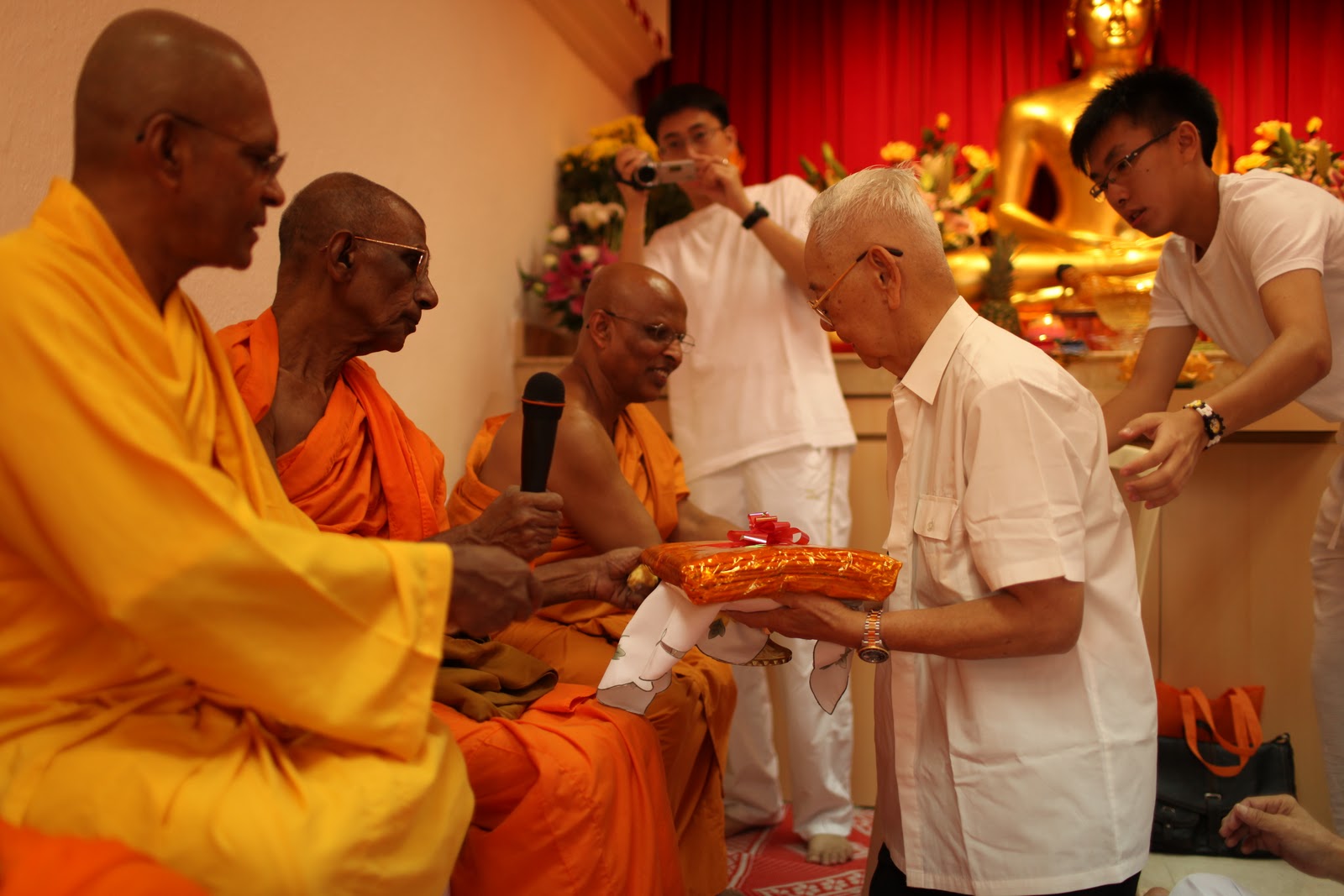
Kathina Celebrations


They are the Blessed One's disciples who have practised well,
Who have practised directly,
Who have practised insightfully,
Those who are accomplished in the practice;
That is the four pairs, the eight kinds of noble beings,
These are the Blessed One's disciples.
Such ones are worthy of gifts, worthy of hospitality, worthy of offerings, worthy of respect;
They give occasion for incomparable goodness to arise in the world.
I chant my praise to this Sangha, I bow my head to this Sangha.
bow.

Filmmaking

BOTIF (Bodhi Motif) Filmmaking Workshop was a 8-weeks basic filmmaking programme organised by the youth group. To celebrate the Mission's 30th Anniversary, we are making a Buddhist-theme short film. Some pictures behind the scenes.

 
The Democratization of Filmmaking

 Mao Mao

This is how we do it.

 The Camera Department

High Tide

Sea Bass go home.

We released 2 sea bass back into the sea as part of the film's plot. Please go back home safely.